> For the complete documentation index, see [llms.txt](https://start.atas.net/llms.txt). Markdown versions of documentation pages are available by appending `.md` to page URLs; this page is available as [Markdown](https://start.atas.net/es/paso-3.-empiece-a-operar-en-atas/estrategias-defensivas.md).
# Estrategias defensivas
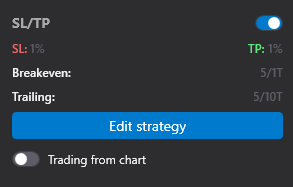
La principal forma de gestionar el riesgo en el trading es establecer stop losses y take profits. No es necesario establecer manualmente órdenes de protección cada vez. En la parte inferior del panel Chart Trader hay una interfaz para configurarlas y gestionarlas.
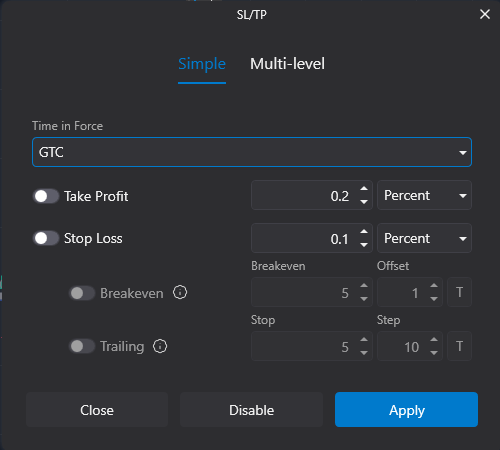
Con la gestión semiautomática de posiciones, el trader puede centrarse en operar en lugar de colocar órdenes. Cuando haga clic en el botón Edit Strategy, accederá al menú de estrategias defensivas, que consta de dos pestañas:
**Simple.** En esta pestaña, puede configurar la colocación automática de take profit y stop loss dentro de un rango seleccionado a partir del precio de apertura de la posición. También puede configurar un trailing stop o transferir al punto de equilibrio (después de configurar los parámetros de la estrategia defensiva, no olvide hacer clic en el botón "Aplicar").
**Multinivel.** Aquí puede configurar varios escenarios avanzados, como cerrar una posición en dos partes iguales cuando se alcanzan TP1 y TP2.
{% hint style="success" %}
El menú de estrategias defensivas de ATAS es un instrumento de gestión de riesgos potente y flexible que le facilitará la protección de sus posiciones y la fijación de beneficios.
{% endhint %}