> For the complete documentation index, see [llms.txt](https://start.atas.net/llms.txt). Markdown versions of documentation pages are available by appending `.md` to page URLs; this page is available as [Markdown](https://start.atas.net/de/schritt-3.-mit-atas-zum-handeln-beginnen/exit-strategien.md).
# Exit-Strategien
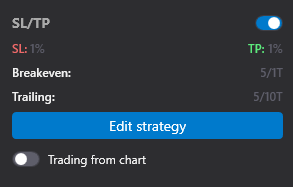
Die wichtigste Möglichkeit, das Risiko im Handel zu steuern, besteht darin, Stop-Loss- und Take-Profit-Orders festzulegen. Sie müssen diese Ausstiegsaufträge nicht jedes Mal manuell festlegen. Im unteren Teil des Chart Trader-Panels gibt es eine Schnittstelle für deren Konfiguration und Verwaltung.
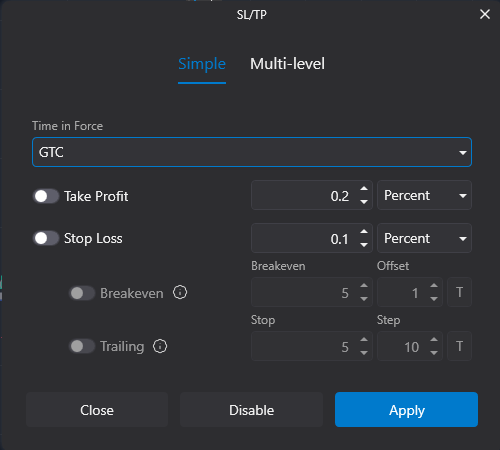
Mit der halbautomatischen Positionsverwaltung kann sich ein Händler auf den Handel statt auf die Auftragserteilung konzentrieren. Durch Klicken auf die Schaltfläche „Strategie bearbeiten“ gelangen Sie zum Menü „Exit-Strategien“, das über zwei Registerkarten verfügt:
**Einfach.** Dadurch können Sie automatisch Take-Profit- und Stop-Loss-Orders in einem bestimmten Bereich ab dem Einstiegspreis festlegen. Sie können auch einen Trailing Stop festlegen oder die Gewinnschwelle anpassen (nachdem Sie die Strategie konfiguriert haben, klicken Sie unbedingt auf „Übernehmen“).
**Multi-Level.** Hier können Sie erweiterte Szenarien anpassen, z. B. das Schließen einer Position in zwei gleichen Teilen, wenn TP1 und TP2 erreicht sind.
{% hint style="success" %}
Das ATAS-Exit-Strategie-Menü ist ein leistungsstarkes und flexibles Risikomanagement-Tool, das den Schutz Ihrer Positionen und die Sicherung von Gewinnen vereinfacht.
{% endhint %}